
Granville County Criminal Court Records
A criminal court record is the case-level file kept by the Clerk of Superior Court once a criminal matter is filed in court. It can include the charging document, warrants returned to court, conditions of release, bond orders, appearances, pleas, motions, hearing settings, judgments, sentencing orders, probation terms, financial obligations, and appeal entries. Arrest information may start with a sheriff or police agency, but the criminal court record tracks the court case.
Granville County is part of North Carolina's unified General Court of Justice. District Court handles misdemeanors and infractions without jury trials. Superior Court handles felony criminal cases and misdemeanor or infraction appeals from District Court. Magistrates, as judicial officers in the District Court Division, may issue warrants, set bail, accept certain guilty pleas and traffic payments, and handle small claims matters.
The North Carolina Superior Court page explains the statewide felony and higher-level trial court role.
That Superior Court role is why Granville felony records and District Court appeals should be read differently from lower-level misdemeanor docket activity.
Granville County Criminal Courts
Criminal records in Granville County often require knowing which court division handled the matter. A misdemeanor or infraction can begin and end in District Court. A felony proceeds in Superior Court after the required charging steps. An appeal from District Court can also move to Superior Court. This division affects where the case is set, which calendar applies, and how the disposition should be read.
| Court Level | Criminal Role | Record Clue |
|---|---|---|
| District Court | Misdemeanors, infractions, juvenile matters, magistrate-related criminal processes. | Often shows lower-level criminal settings and non-jury matters. |
| Superior Court | Felonies, major criminal trials, and District Court misdemeanor or infraction appeals. | Often shows felony proceedings, indictments, trial settings, and sentencing. |
| Magistrate | Warrants, bail, certain guilty pleas, and first-stage criminal processing. | May appear through warrants, bond conditions, and first appearances in the case file. |
The North Carolina District Court page describes the District Court mix of civil, criminal, juvenile, and magistrate matters.
That District Court role explains why Granville misdemeanor and infraction records may look different from felony Superior Court records.
Search Granville Criminal Court Records
The main online search route is the statewide NC eCourts Portal. Use Smart Search for criminal case information and Search Hearings for court dates. Search by case number when known, or search by defendant name in Last, First Middle Suffix format. Advanced filtering can narrow by Granville County, case type, case status, file date, date of birth range, gender, ethnicity, phone number, FBI number, SO number, or booking number when those filters apply.
- Open the NC eCourts Portal and choose Smart Search for case information.
- Search by criminal case number or defendant name.
- Select Granville County when the search should be limited to local cases.
- Review the docket entries for charges, hearings, pleas, disposition, and sentencing terms.
- Use Search Hearings for a future court date or courtroom lookup.
- Request a certified copy or certified county criminal record search from the Clerk of Superior Court when official proof is needed.
Official Judicial Branch guidance says criminal case information is available through public self-service terminals at a clerk of court's office in any county, with searches by defendant name, case number, and victim or witness name. For Granville County criminal court records, the complete file and certified search route still runs through the clerk in Oxford. Portal is useful, but it does not replace a clerk-certified result.
For the narrower arrest-to-charge path, including how a charge can be reduced, dismissed, or superseded after arrest, use the related Granville County arrest records and court charges material.
Granville Criminal Case Flow
A criminal case file grows as the court acts. A charge may begin through a warrant, citation, complaint, or indictment. Court records then add appearances, bond conditions, motions, plea activity, trial events, judgments, sentencing, costs, probation terms, and appeals. Each event may create a docket entry, order, or other case document.
Case flow: Charges Filed › Arraignment › Pretrial / Motions › Plea or Trial › Disposition › Sentencing
| Stage | What Happens |
|---|---|
| Charges Filed | The case begins with an accusation such as a warrant, citation, complaint, indictment, or other charging paper. |
| Arraignment | The charge is formally addressed and a plea may be entered or scheduled. |
| Pretrial / Motions | The record can show motions, continuances, discovery-related orders, bond changes, and calendar settings. |
| Plea or Trial | The defendant may plead, or the case may proceed to trial depending on the court level and charge. |
| Disposition | The record states whether the charge was dismissed, reduced, found guilty, found not guilty, or otherwise resolved. |
| Sentencing | The judgment may list punishment, probation, costs, fines, restitution, and appeal activity. |
What Granville Criminal Records Show
A Granville County criminal court record should be read field by field. A case may list charges that are later dismissed or reduced. A plea may not be the same as the original accusation. A disposition may apply to one count but not another. Sentencing may add probation, costs, restitution, or appeal terms after the disposition is entered.
| Field | What It Shows |
|---|---|
| Case Number | The official criminal case identifier, with Portal payment examples using formats such as 15CR123456-910. |
| Defendant | The person charged in the criminal case. |
| Charges | Offense description, statute, class, offense date, charging agency, warrant or citation number, and bond information when public. |
| Hearing Entries | Court dates, hearing type, courtroom, judicial officer, continuances, motions, pleas, and trial settings. |
| Plea | The defendant's formal response to a charge, which may appear before final disposition. |
| Disposition | The outcome of a charge or case, such as guilty, not guilty, dismissed, closed, disposed, or another final status. |
| Sentence | Punishment or conditions imposed after conviction, including probation, costs, fines, restitution, or related obligations. |
| Redactions | Restricted personal details, juvenile information, protected addresses, or sealed material removed from public view. |
Granville Charges vs Convictions
A charge is an accusation. A conviction is a finding or admission of guilt. Granville County criminal court records can show charges that were dismissed, reduced, superseded by indictment, or resolved by plea. A search result should not be read as a conviction unless the disposition or judgment shows that outcome.
| Point | Charge | Conviction |
|---|---|---|
| Meaning | An allegation filed in court. | A guilty finding, guilty plea, or other conviction result. |
| Timing | Appears early in the criminal process. | Appears after plea, trial, or judgment. |
| Record risk | May later be dismissed, reduced, or changed. | Usually connects to sentencing, costs, probation, or appeal rights. |
| Best check | Review the charge count and docket activity. | Read the disposition and judgment fields. |
Note: A Granville County criminal court record can list an accusation even when the final disposition is not a conviction.
Granville Criminal Case Parties
Granville County is in Prosecutorial District 11 with Franklin, Person, Vance, and Warren counties. The official District Attorney page identifies Mike Waters as District Attorney. The Granville office is at the courthouse in Oxford and prosecutes state criminal cases, represents the State in criminal and some juvenile matters, prepares criminal trial dockets, and advises law enforcement. The DA's decisions can appear in the criminal case file through dismissals, plea arrangements, trial calendars, judgments, and sentencing.
The official Prosecutorial District 11 page documents the Granville office and the DA's role.
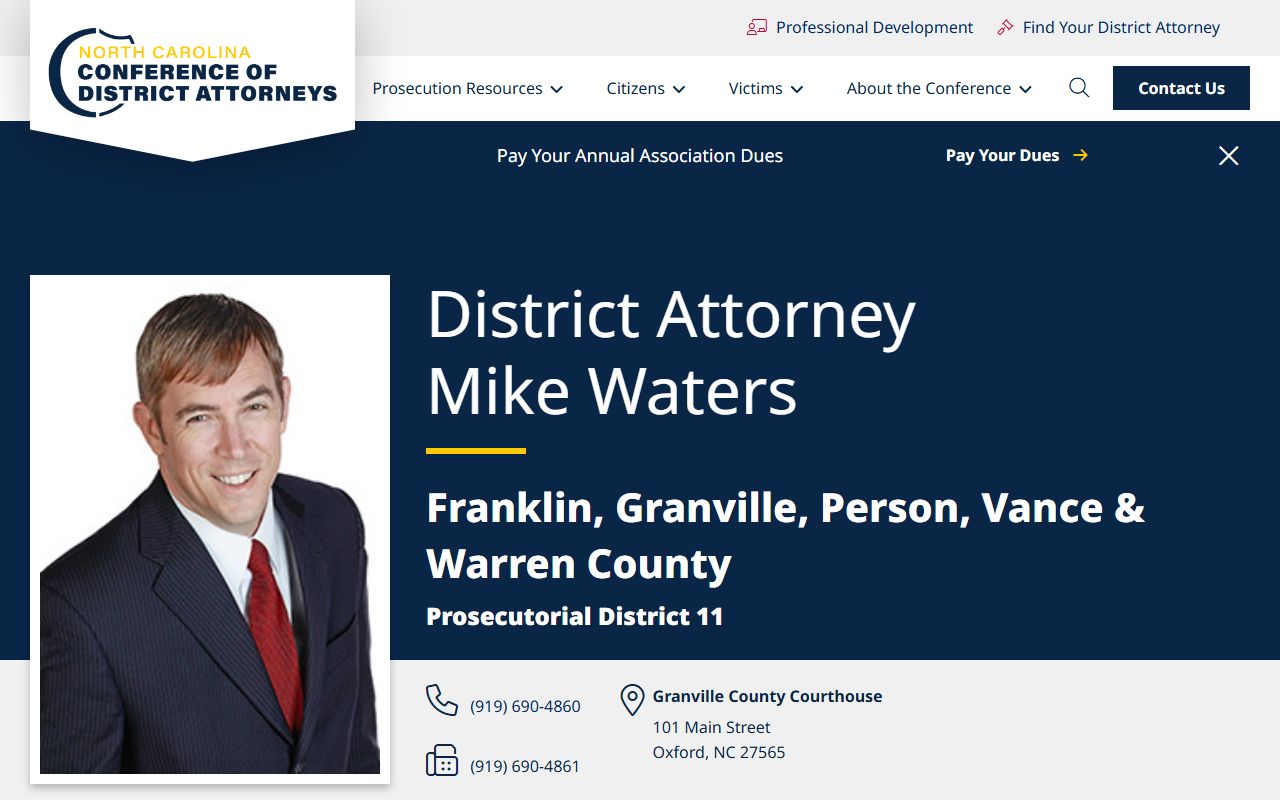
That source helps explain why prosecutor action can change how a charge appears in the final criminal court record.
Public defense is routed through North Carolina Indigent Defense Services. The NCIDS Granville page lists Defender District 9 and Regional Defender Daniel Meier, and it tells users asking whether they have a lawyer to contact the Clerk of Superior Court at 919-690-4800.
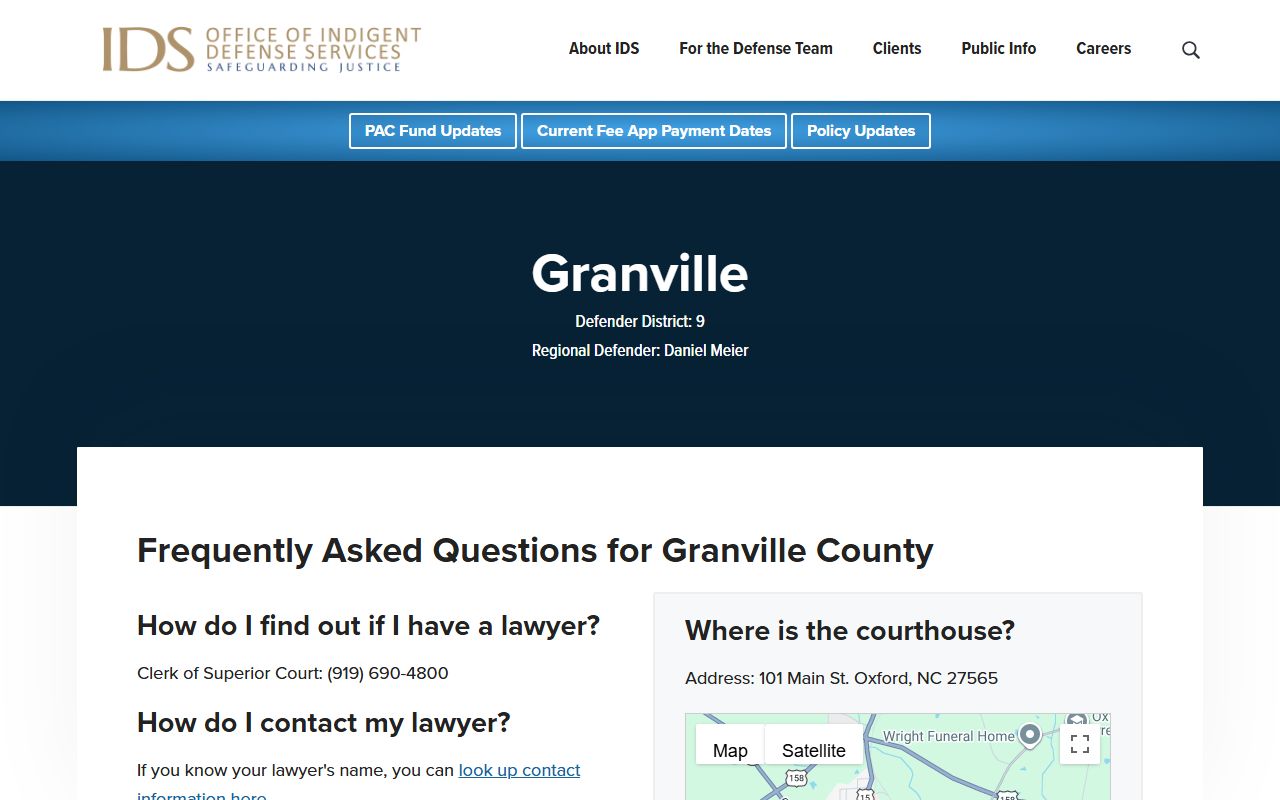
That appointed-counsel routing is tied to court records because representation, appearances, and counsel changes may appear in the criminal case docket.
Access Granville Criminal Records
North Carolina gives public access to many court records, but criminal records can include both open and restricted material. G.S. 7A-109 makes clerk-maintained court records open for public inspection during regular office hours unless law blocks access. G.S. 132-1 defines public records broadly for state and local government records.
Portal gives a public first look. Clerk terminals provide another public search channel for criminal case information. The Clerk of Superior Court provides the complete file, certified copies, and certified county criminal record checks. The official Judicial Branch background-check page says people should use the county clerk's office for official searches rather than relying on Portal.
North Carolina's public-record definition is one of the statutes linked in the research for criminal court access.
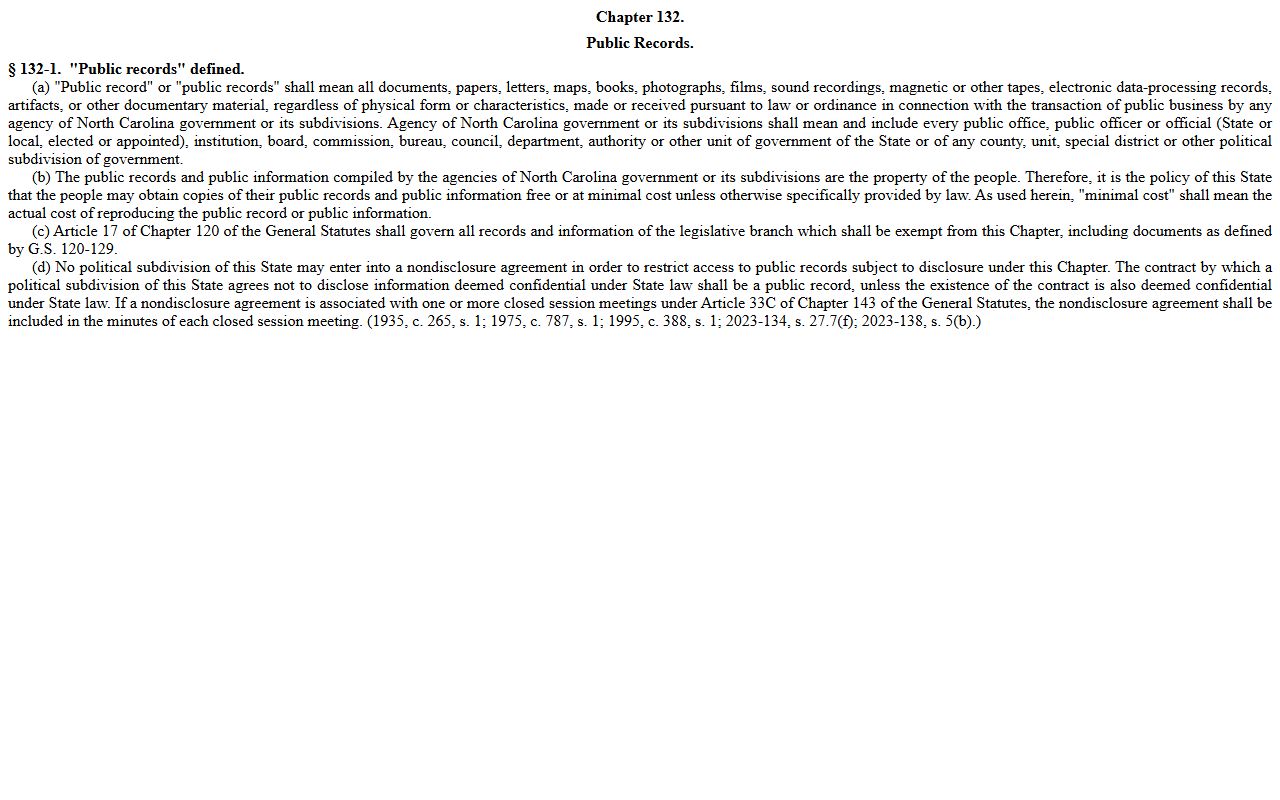
That public-record statute supports access in general, while court-specific and confidentiality laws decide what a person can actually inspect.
Sealed vs Expunged Granville Records
Sealed and expunged criminal records should not be treated as ordinary public case records. A sealed record is restricted by court order or law. An expunged record is confidential under North Carolina law and kept outside the ordinary public file. Public Portal results may not show these records, and the clerk cannot release confidential files just because a person knows a case once existed.
| Point | Sealed Record | Expunged Record |
|---|---|---|
| Public visibility | Hidden from ordinary public access by sealing rule or order. | Removed from ordinary public access and retained in confidential files. |
| Legal source | Depends on sealing authority, case type, or court order. | G.S. 15A-151 governs confidentiality of expunction records. |
| Access route | Only if the sealing order or another law allows access. | Ordinary public access is cut off after the expunction is processed. |
| Practical effect | The case may exist but details are restricted. | The public record is removed from ordinary view, though agencies may need processing time. |
The expunction confidentiality statute is directly relevant to Granville County criminal court records.
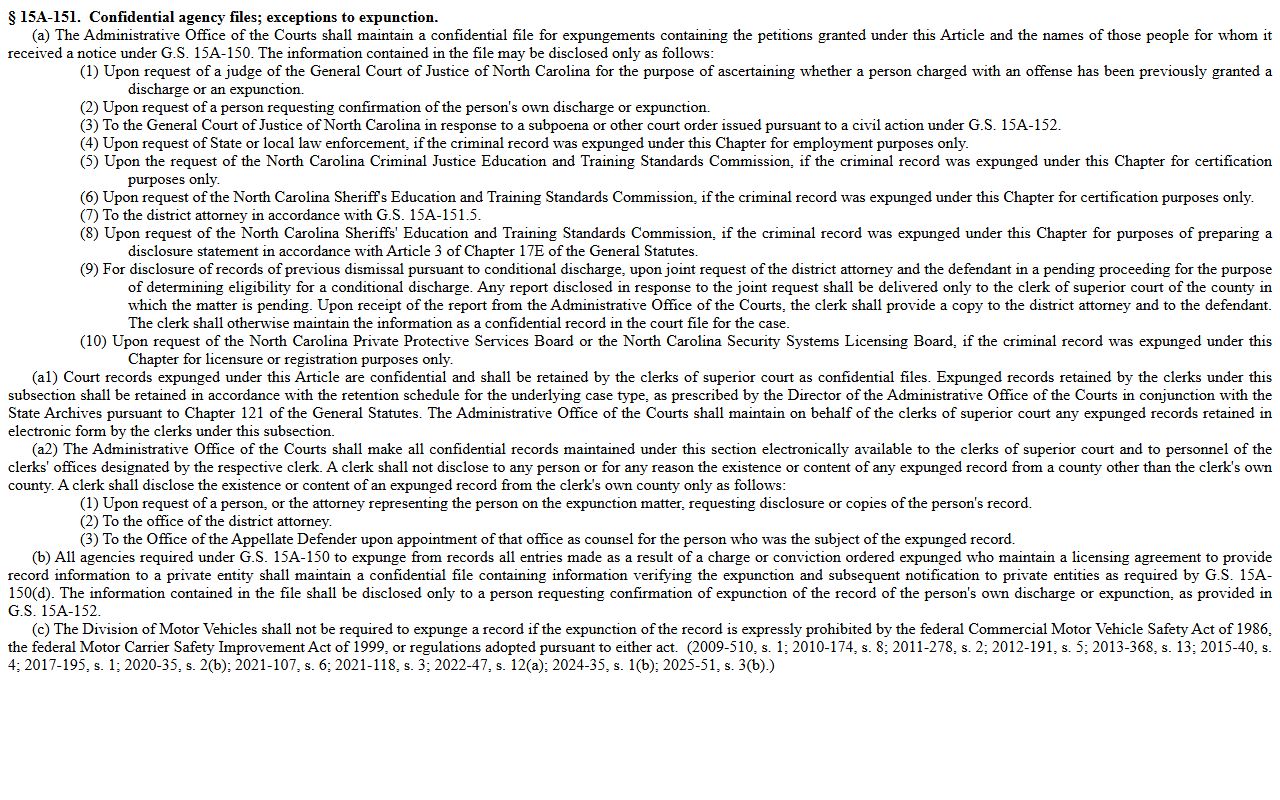
That statute explains why an expunged criminal record is not found through routine Portal or clerk public searches.
Restricted Granville Criminal Records
Juvenile delinquency and undisciplined juvenile records are restricted by Chapter 7B. Abuse, neglect, and dependency juvenile records are also not ordinary public files. A criminal case can also have redactions for Social Security numbers, account numbers, dates of birth, minor identities, protected addresses, and other sensitive details. Mental health-related material and sealed filings may be unavailable even when a docket line is visible.
Expunction eligibility depends on the charge, conviction status, age at offense, waiting periods, prior convictions, and statutory exclusions. A person seeking expunction must identify the statute that fits the record and file in court, often in the county where the charge occurred, using required AOC forms. If granted, the clerk and state agencies process the expunction order.
Granville Criminal Record Requests
The Clerk of Superior Court at the Granville County Courthouse is the key office for Granville County criminal court records. Use the clerk for complete file inspection, certified copies, certified county criminal record searches, and questions about whether appointed counsel has been assigned. Portal is a search tool. The clerk's file is the official court source. Sheriff Robert D. Fountain, Jr. and the Sheriff's Office may hold separate arrest or jail information, but the court case file remains with the clerk.
Granville County Clerk of Superior Court
101 Main Street
Oxford, NC 27565
919-690-4800
Use for criminal case files, certified searches, copies, and appointed-counsel routing.
The District Attorney's office is also in the courthouse, at 101 Main Street in Oxford, with phone 919-690-4860 and fax 919-690-4861. The DA cannot give legal advice to charged persons about charges, insurance points, or driver-license points, but prosecutor activity becomes part of the criminal court file through court filings and dispositions.